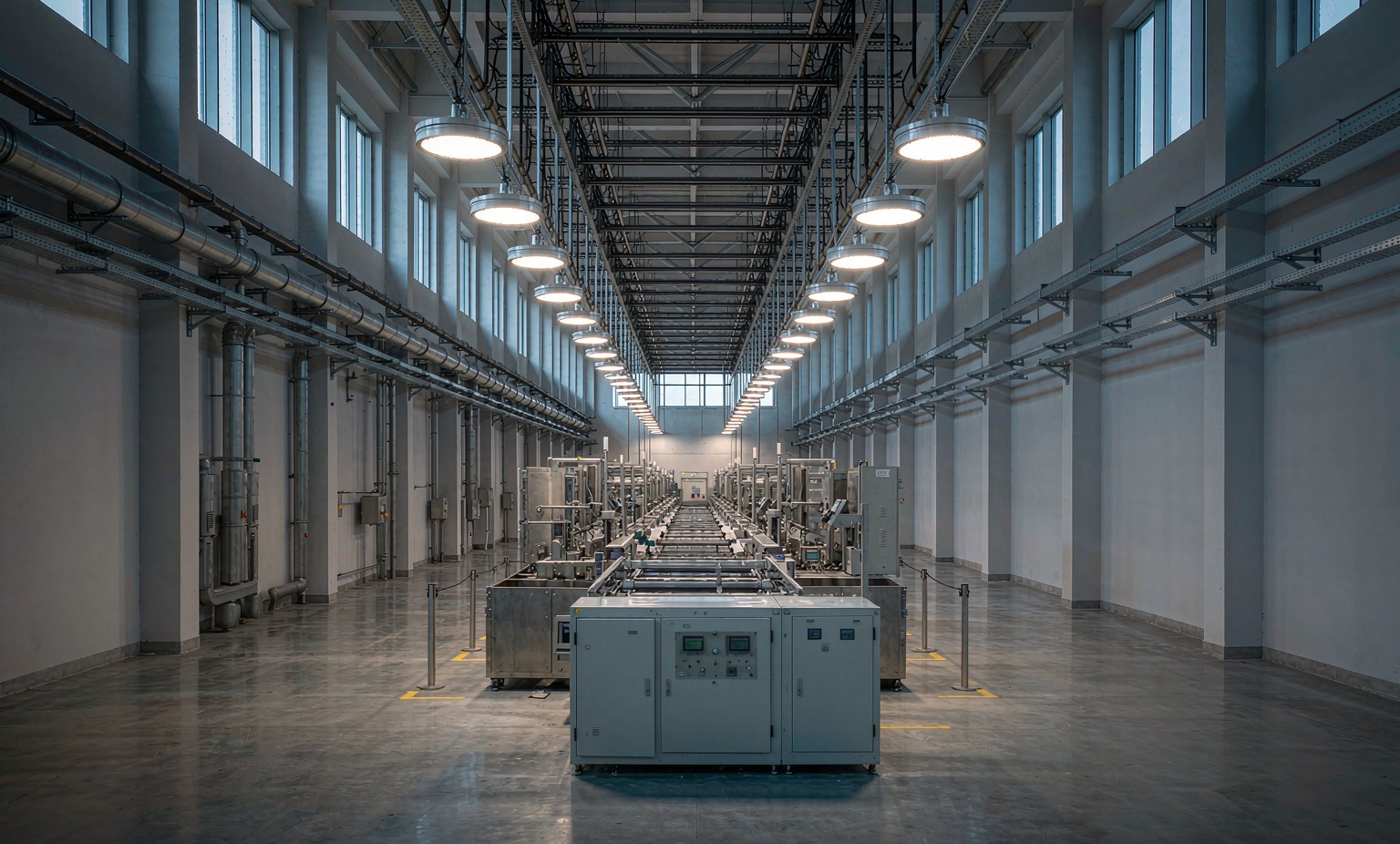
Production hall with an instrumented distribution board and conduit runs along the wall
Brownfield industrial IoT

Instrument the plantyou already have.

From the breaker to the cleanroom ceiling: LED luminaires, circuit-level metering, remote switching, variable speed drives, FFU control, LED walls, face access and AI video — installed onto the DIN rail and cable tray that are already in the building, and landed on one platform. No rip-and-replace, no line stop, no six-month shutdown.
14Sites instrumented
8,600Points under management
2.8 MWControllable load
Retrofit, not rebuild Clamps on live conductors, DIN-rail breakers, no panel replacement.
Open protocols Modbus, BACnet/IP, OPC UA, MQTT, DALI-2. Your SCADA keeps working.
Savings against a metered baseline IPMVP-style verification, not a number from a brochure.
Accountable after handover Named engineer, tiered SLA, 4.2 h median time to restore.
Where we work / 05 environments

Five kinds of site, one tag model.

All solutions
Hardware / 36 product groups

Everything from the breaker to the cabinet.

View full catalog
Beyond the meter

The groups a retrofit quote usually leaves out.

Metering and lighting are where a retrofit starts. They are not where it ends. The same plant has motors that still start at full torque, a room that has to hold a pressure differential, a gate that has to decide who comes through it, and a control room that has to show all of it at once. These five are the groups a retrofit quote usually leaves out, and they are here because our own projects kept buying them from three other suppliers and then paying an engineer to make them agree with each other. The full range is 36 groups and 266 models — the switchgear, the contactors, the sensors and the cable glands that a retrofit actually consumes.

All 36 groups
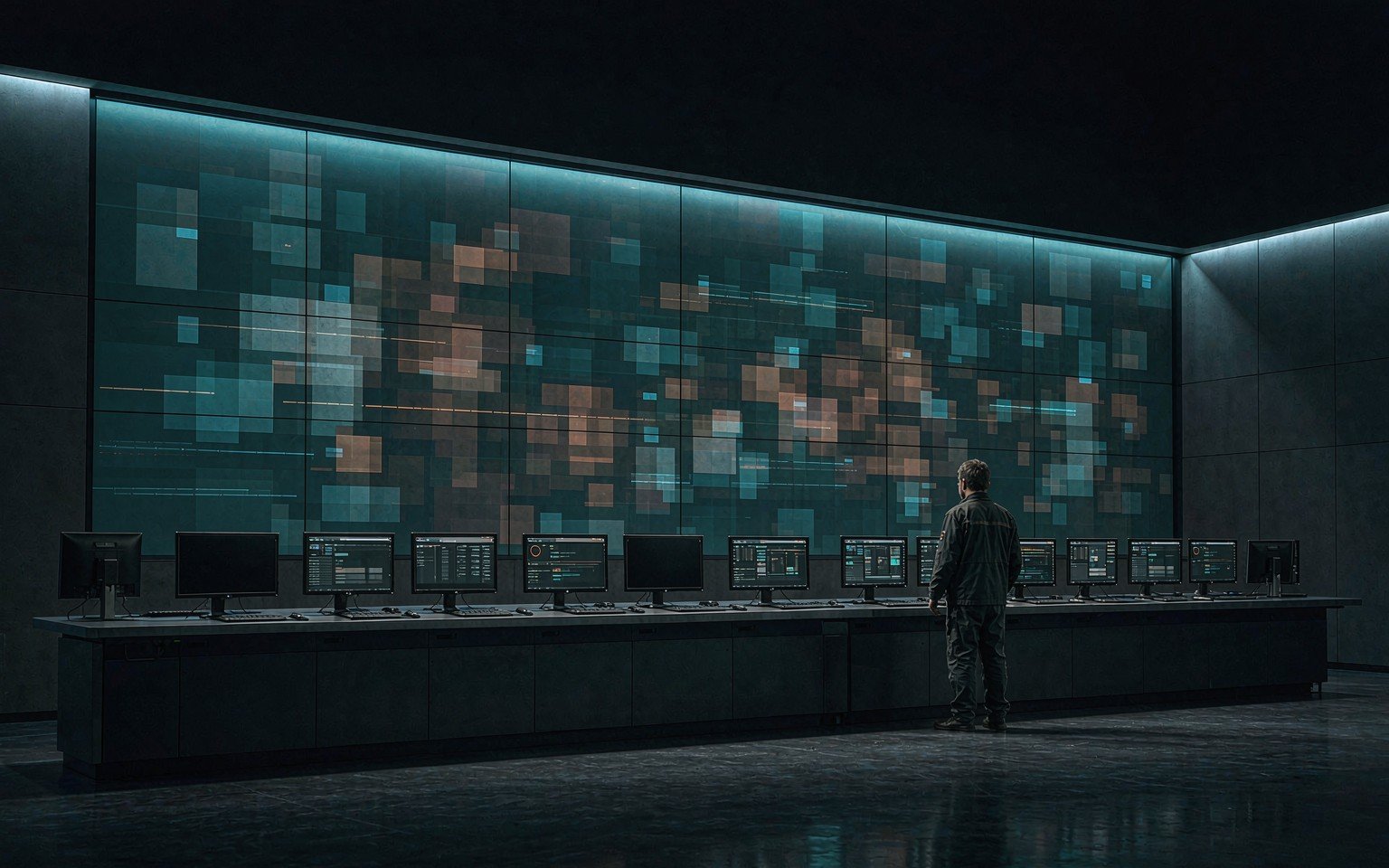
Plant control room at night, an operator at the console in front of a four by two LED wall
Control room — 4 × 2 wall of P2.5 cabinets on our own wall processor, eight sources, one console. The platform's own dashboard is one of the eight, which is how a wall ends up showing the plant rather than a slideshow.
Scope / what 2026 changed

Four categories we stopped quoting this year.

Not because they were hard to build. Because a regulator closed them. On 28 July 2026 grid-tied inverters and mobile robots went onto the FCC covered list — by country of production rather than by company name, which is the part that catches people out. A supplier who is still pricing either of those for you is either working from an old price list or hoping you will not ask.

The full matrix

The remaining closed categories, the four approval gates that decide all of this, and the exact words we use about origin are on the compliance page. It is the least commercial page on this site and the one we would want read first.

Lighting

The line that pays for itself first.

Lighting is the only part of a retrofit that usually clears its own cost inside a year, because the waste is in the fixture rather than in the process. The arithmetic below is per fitting at 4,000 operating hours — a single-shift plant. A three-shift plant multiplies every row by three.

The luminaire range
High bay luminaires over a production hall
ExistingActual drawReplacementSaved / year
400 W metal halide high bay≈ 440 W with ballastUFO High Bay 150 W1,160 kWh
2 × 36 W T8 fluorescent≈ 90 W with ballast2 × T8 LED 18 W216 kWh
250 W HPS high bay≈ 285 W with ballastUFO High Bay 100 W740 kWh
150 W HPS wall pack≈ 175 W with ballastFloodlight 60 W460 kWh

At 4,000 h and $0.11 / kWh, the first row is about $128 a year against a $128 fitting — before utility rebates, and before the dimming saving, which is the larger number on a warehouse with daylight. Nothing here is a modelled figure: it is watts at the board multiplied by hours, and it is the calculation a plant engineer will redo on the back of the quotation.

Two things a specification has to say out loud. A ballast-bypass tube is not reversible and is an electrician's job — the ballast has to come out of circuit, which is why the saving is real. And none of these fittings is rated for a hazardous location; a paint booth or a flour silo needs a different product and a different certification.
Specified most often

The four that start most projects.

See all products
How a retrofit actually runs

Six things that decide whether it works.

01 / THE CONSTRAINT

The plant cannot stop

Every other vendor quotes a weekend line stop. On a plant running three shifts with a customer penalty clause, that is not a scheduling problem — it is a veto. So the work has to happen on live circuits, in the gaps between shifts, or not at all.

02 / THE METHOD

Clamp, do not cut

Split-core CTs clamp over an existing conductor. The three-pole breaker replaces a breaker in the same slot and the same enclosure. No feeder is isolated, no cable is cut, and the only tool the electrician needs that they do not already own is a laptop.

03 / THE HARD PART

What the old kit speaks

A plant built in stages has a 1998 BACnet controller next to a 2023 Modbus meter next to something with a serial port and no documentation. Nine out of ten delays are here, not in the hardware — which is why the protocol audit happens before the quote, not after.

04 / THE DATA

One tag model

Every protocol is normalised into the same tag tree: site, building, panel, circuit, point. It is unglamorous and it is the entire difference between a dashboard that survives year two and forty point-to-point integrations that nobody can maintain.

05 / THE PROOF

Baseline before savings

Two to four weeks of metered baseline before anything is switched. Without it, a savings figure is a claim; with it, it is a measurement both sides can audit — and the number a lender will actually accept when the project is financed against the savings.

06 / THE HANDOVER

Who answers at 3 am

An alarm at three in the morning on a Sunday is the only test of an installation that matters. Contracted sites get a named engineer and a response time in the contract, not a ticket queue and an autoresponder.

The platform

DOUBLENING OS — one tree, six modules.

How the platform works
Asset tree
▾ Toledo — Plant 2
  ▾ Panel DP-14
    · L1 Extruder 63 A
    · L2 Extruder 63 A
    · L3 Chiller 32 A
  ▾ Panel LP-03
    · Aisle lighting
  ▾ Gate 4
    · Camera 04 · AI
  ▾ Cold room 2
    · Temp probe

2 gateways · 41 devices
last poll 00:00:02 ago
Plant 2 — last 24 h
41.2MWh today
1.84MW peak
0.94Power factor
criticalCold room 2 above setpoint for 6 min02:14
warningDP-14 phase imbalance 11%01:47
infoAisle lighting held at 40% — daylight23:58
infoPeak shed 0.4 MW, 22 min, no line impact22:30
Illustrative interface. Live data shown on a call, not in a screenshot.
14Sites instrumented
8,600Points managed
19%Median energy cut
99.9%Measured uptime
Reference projects

What it looked like on the meter.

All projects
IEC 60947-2Breaker standard, catalogue basis
IEC 62053-22Class 0.5S metering accuracy
ONVIF S / TVideo interoperability
FCC Part 15 BUnintentional radiator, Class B
Speaks

It has to talk to what is already there.

Channel programme

Built for integrators, not for a shopping cart.

Deal registration, project pricing from a single site, and a named application engineer for every registered opportunity. Approval is one business day with a valid electrical contractor licence or an existing systems-integration business.

Apply as a partner
12–22%Off list price
Net 30Integrator terms
1 dayApproval turnaround
Before anyone quotes

Three questions we ask first.

Send us a panel schedule.

One photo of a distribution board and a line count is enough for a first conversation. We come back within two business days with a point count, a protocol risk list and a budget range at ±20%.

Start a project enquiry